
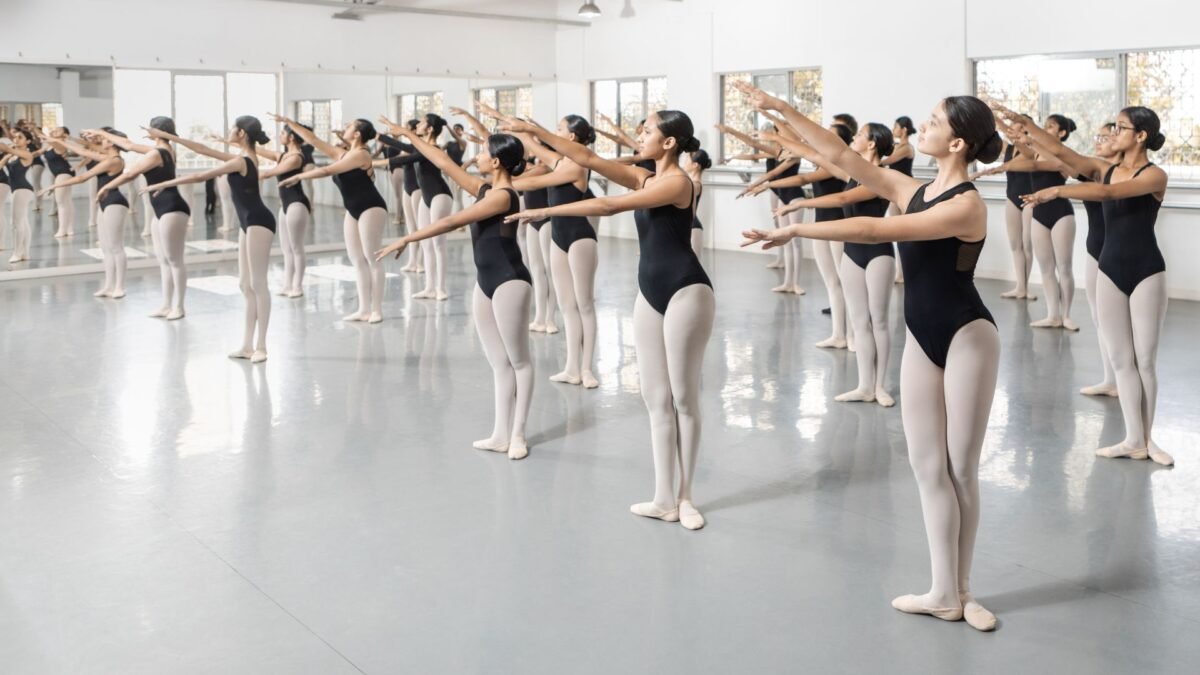
By Arpritha R Bhat
It’s the year of the long awaited ISTD exams! Are you new to the world of ballet exams? Or have you done them before and want to do your very best? Look no further! This article will give you valuable advice from Miss Yana on just that.
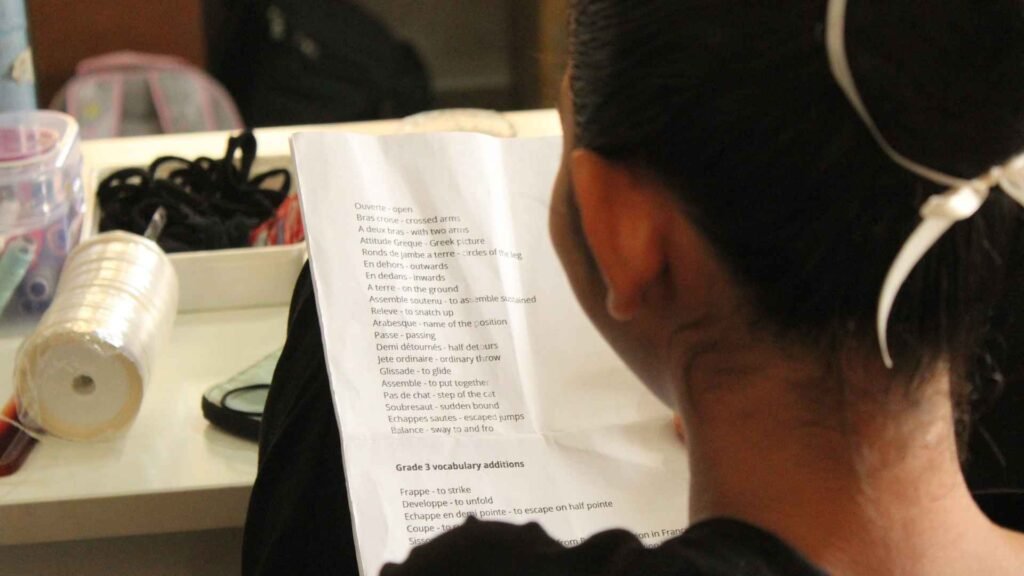
A student brushing up vocabulary before the examination.
How long in advance should students start preparing for an exam? And is there a right way to prepare?
“Students should prepare for an exam the second they finish the previous exam. It should be an ongoing process, not something we wait till the last minute to start doing. If you’re ready to take an exam, I should see that you’re ready. You’re not going to suddenly improve in the last four or five months. You should always be evolving and it’s not something we should just save for an exam.
Make yourself remember corrections that are given to you, before I say them again. That’s the key that’s going to help you through an exam, but everybody forgets until I remind them again and again and again and again. Writing corrections down earlier on and then re-reading them before classes is a really good way to prepare in advance.”
What area should students focus on most during the preparation process?
“Students should focus on their personal corrections. General corrections in a class are well and good, but personal corrections are exact—in that moment, in that exercise. It’s better to record this exercise, this correction, this exercise, because that way when you read it before a class it stays fresh in your mind. If it’s a week later, then you’re going to forget it until you’ve already made the same mistake.
Also start practising. If you start practising early on, you’re going to eliminate corrections. Eliminate everything that the teacher says, so by the time of the exam I have nothing left to correct.”
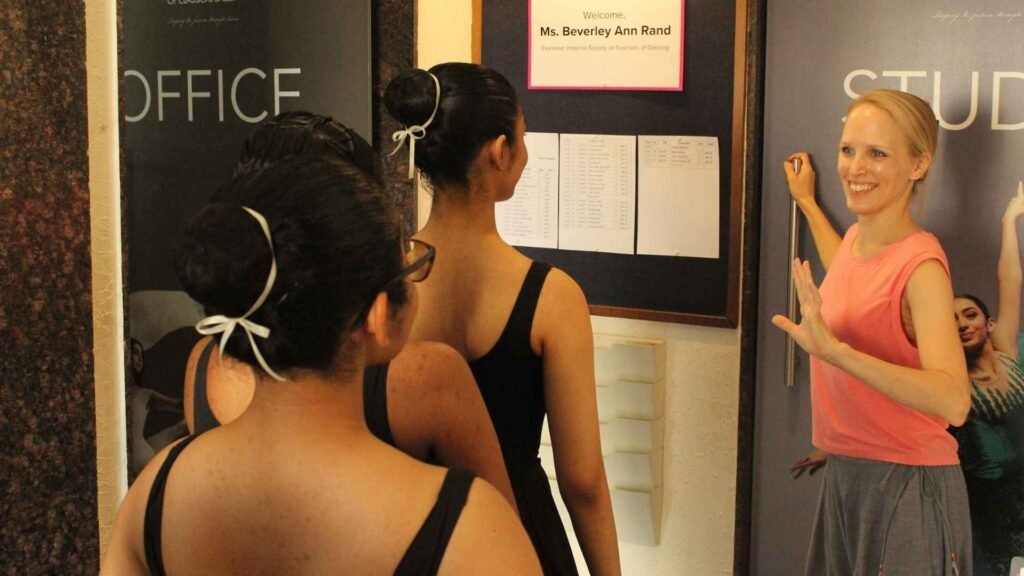
Students preparing to head into the examination studio.
Are there any recommended resources like books, videos, workshops, etc. to help with exam preparation?
“No. Books and videos are all well and good, but when you watch something you become a zombie. It’s better to practise it. You know the work and you should just practise it with your own corrections in mind.
If you’re taking a vocational exam, the professional exams, then I think you could watch the set video, which is a teacher’s resource, but if you use that as your benchmark then you don’t get what I want out of it. I’m using the syllabus really as a base to build on and not using it as the ultimate goal. I think that it’s important to keep that in mind and realise that my benchmark is very different.
Listening to the set music over and over again—does it help? Yes, if you’re counting it correctly, but I can’t tell that unless you’re actually doing it in the studio.”
How can students effectively use visualisation and mental rehearsing techniques?
“Visualisation? I don’t know. I think that comes more when you’re learning choreography. I think if you visualise the dance, you see the pattern, you see the picture, it will help, but not in an exam. Going through the exercises with placement of arms and heads is worth it. Not actually jumping it, but going through it.
Eye line will be important, as it is a one-on-one situation. There’s an examiner and four students, so you have to present to her. You’re not presenting up to the fans on the ceiling. So I think that’s important to remember.
The more complicated exercises that involve more transference of weight, fast, quick transitions are where most students will lose marks, because they can’t transition fast enough between steps. If I do it slowly in class they all get it right, so building up speed on your own would be helpful.”
What are your recommendations for maintaining physical health and avoiding injury during this time, along with any tips for managing stress and staying focused?
“If your placement is good, if your weight transfers are fast and quick, you won’t injure yourself. The students who injure themselves are the ones who hold back, who are not on their legs, whose weight can’t shift between their feet fast enough. Especially if I do a fast allegro, many students struggle to keep up, and these are the students who are more prone to injury. Work on building up the speed in which you can shift your weight and transition from forward to back to side to side.
Eating healthy—is it going to help injury? Yes. Does it help all teenagers through injury? No. Some are going to get injured if they’re not fit enough. They haven’t been to classes regularly. Their bodies are not ready to do the job. The higher the general fitness, the better. So doing something at home? Yeah, you can run outside, go running in a park, swim. If you can get your general fitness levels higher, you’re less likely to injure yourself.”
Classical Ballet exam students with Ms. Beverly Ann Rand in 2024.
How can students best use feedback from teachers to improve their performance before the exam?
“Like I said, make a book, write down your corrections. The best way to use corrections is to actually remember them. The first step is remembering, the next step is noting it down and reading it before you do the class again. The next step is catching yourself before you make that same mistake. It’s hard. The more you go through the syllabus, the easier it gets. You have to just keep repeating sections of it.
You can do barre work and adage at home. When you’re at the studio, work on allegro, or you go through the steps at home.”
How can students improve their technique in the lead up to the exam? Are there any specific exercises you recommend for learning particular skills like turnout, balance and jumps?
“In all honesty, is the technique going to get any better in the last two weeks before the exam? Probably not. What’s going to get better is the quality and performance. The way you present the work should improve because you should be thinking less about what you’re doing and more about how you’re performing it.
Turnout exercises are great. Everyone taking an exam should do them every day. If your turnout holds you, you can do so much more with your body. The clams with the TheraBand are really good to do, and leg strengthening and abs, always. You can’t ever do enough abs.”
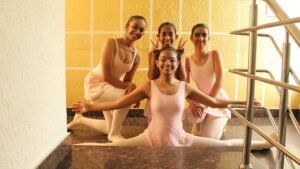
Students after their examination.
What is something that makes helping students prepare for their exams special for you?
“It’s often not the people who are totally ready, but the people that you feel should take the exam but are not there yet. You have to find new ways of bringing their confidence up and getting them through the exam.
The most unlikely candidates can make me feel the most proud because it takes a lot of personal understanding to work with those students to get them through a ballet exam. It’s very easy to get a good student through a ballet exam, so I enjoy the challenges of less physically able students getting a really good mark in a ballet exam.”
What advice would you give students if they make a mistake during the exam?
“Yeah, when they make a mistake, they normally panic and then they can’t get anything right afterwards. It’s human nature to make a mistake. It’s easy to mess up your entire ballet exam afterwards and then really be upset with yourself. It’s not worth it. It’s just a ballet exam.
You just smile sweetly and say, ‘I’m really sorry I messed that up.’ Take yourself lightly because that’s the way you get over it faster.”
What advice do you have for improving stage presence and artistry during the exam? How can students ensure they are conveying the right emotions and expressions in their performances?
“Really listen to the music, it will tell you what quality you should portray in an exam. If the music’s powerful and strong, then that’s how you need to be. You need to show different sides of yourself. If you just go into the exam and grin from beginning to end, it’s not going to work out well because all the music’s different. Musicality and performance will get you through any exam.”




Leave a Reply