

Article by Ahana Ayyaparaj for En Avant Winter 2025

Holly Hynes
We hear from Holly Hynes, an award-winning costume designer with credits in over 300 ballets, including more than 70 for New York City Ballet. Her work appears in major companies worldwide – from The Bolshoi Ballet and The Royal Ballet to American Ballet Theatre, La Scala, and Paris Opera Ballet – as well as many North American companies such as San Francisco Ballet, Houston Ballet, and Pacific Northwest Ballet. She also served as Resident Costume Designer for The Suzanne Farrell Ballet at the Kennedy Center in Washington, D.C., for 19 years.
What inspires your costume designs for different ballets?
I am first and foremost inspired by the music. I will listen to the score over and over until it is under my skin. I am often inspired from there by my surroundings – color combinations in nature for example. I spend some time researching a subject or a different time period or even artists paintings.
How do you incorporate tradition alongside innovation whilst designing classical pieces?
I will often tell young designers who think they want to work in the field of dance that designs for classical ballets need to respect the past. Don’t copy what has gone before you, but be inspired by it. I was lucky to spend over 20 years with the New York City Ballet and their historical closet filled with original samples of Karinska’s work. No better designer to learn from. Ease into the idea, pull back from over designing. Leave a place for the eye to rest.
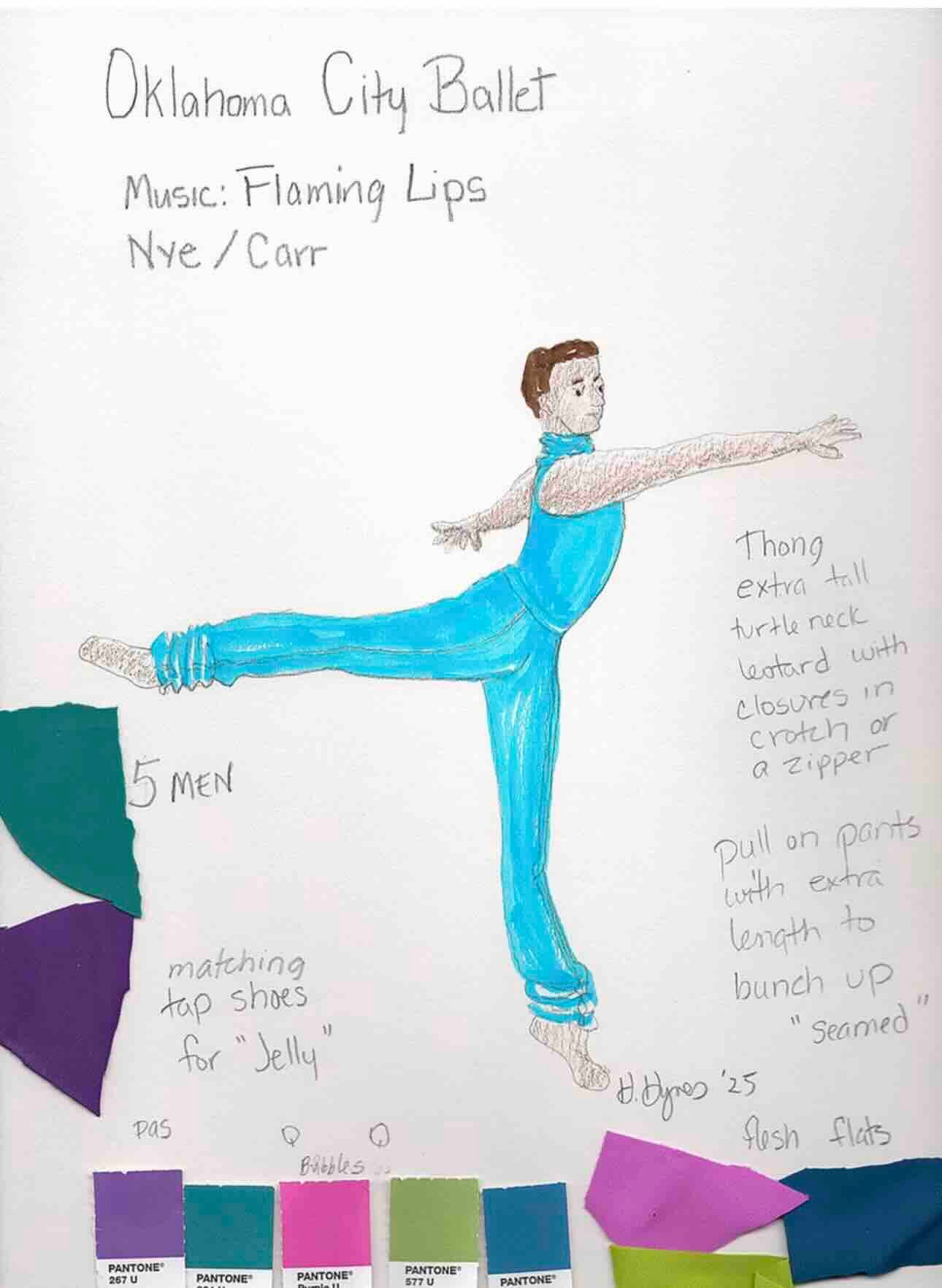
“The Flaming Lips: The Ballet” Oklahoma City Ballet. Ryan Jolicoeur-Nye, Choreographer, 2025.
What is your process of creating a ballet costume?
Let’s start after the research and the music. I try to put pencil to paper first. I hate to waste time redrawing so I will send this first round with no color to the choreographer. That way I can erase the pencil line. Once we have agreed on the shape and line of the idea then I work with water color. Some times I will even share tiny Pantone chips of color with the choreographer to make sure I am in the right world. Everything is scanned and sent through email.
Next my team and I collect bids from shops and decide who we can afford to make the costumes unless the ballet company has it’s own shop (this is ideal and usually much less expensive).
Now a team of shoppers takes my instructions and heads off to the fabric stores to swatch the fabrics and collect color cards. We will do this same shopping day looking for trims and buttons and anything else we might need. Once the fabrics are picked and distributed, I work with a Draper in the shop to answer all of their questions before they drape a piece of muslin, a cotton, plain, inexpensive fabric on a mannequin to help the first hand mark out the pattern. Then the machine stitchers put a mockup together to try on a dancer. This saves the fabric before it is cut into since changes often happen.
Meanwhile this is a good time to adjust colors of fabric in the dye room if changes are necessary. It’s also a good time to share ideas with a milliner if the ballet has hats or headpieces.
I usually travel to the dancers with the draper to have a first fitting. We always try to have two fittings before we are ready to see everything on stage. Tech’s and dress rehearsals usually happen within the two weeks before the opening.
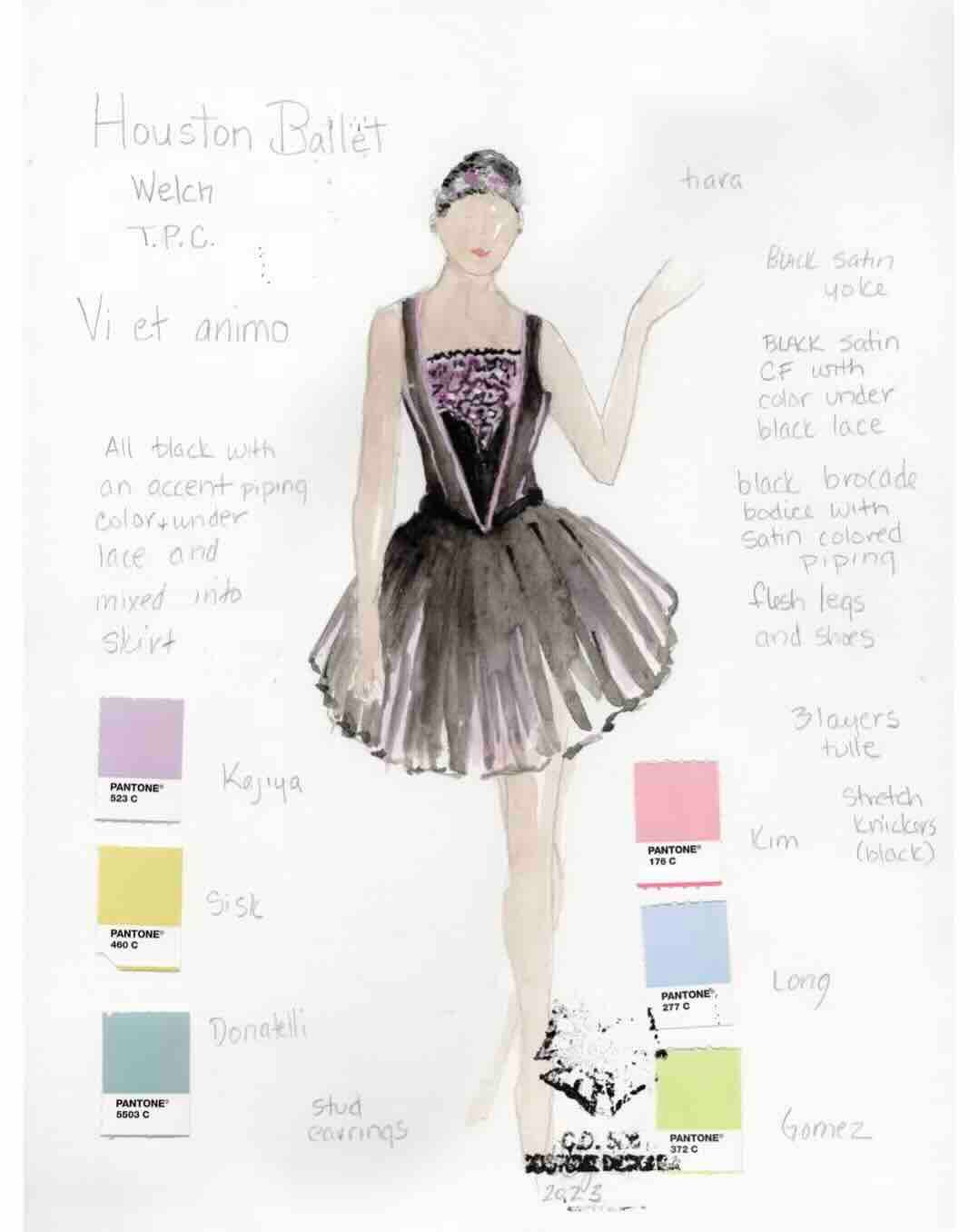
“Vi et Animo” : Houston Ballet Jubilee of Dance. Choreographer – Stanton Welch, December 2023. Principal costume. One of six.
How do you ensure the costumes allow full freedom of movement and are comfortable to dance in?
I have loads of different tricks up my sleeves. Spandex, a dyeable stretch fabric, can be dyed to match non stretch. Then this can be inserted in
side seams or sleeve seams. Cutting non stretch fabrics on the bias also allows for breathing room.
Have you ever had to adapt your designs for different cultures or countries?
I am adjusting a section in a recent Nutcracker design to raise a bodice on 8 young ladies so as not to show so much of their cleavage. Nutcracker in recent years has become careful to not promote cultural stereotypes. I have delicately tried to represent the countries represented in my Nutcrackers by trying to create recognized images that bring joy to children in the audience without conjuring stereotypes.
What was the most difficult costume to design and why?
Years ago I designed a full length ballet based on the novel Tom Sawyer. The director/choreographer wanted children as fireflies and moon beams in the cemetery scene. The moonbeams were painted with moons in various stages on grey leotards with tiny tutus. We tried painting them with paint that would glow under black light. Since the stage was so big it was impossible to get enough light on the little girls to make them glow. It sort of worked.
What’s your favourite costume design that you have created?
I always say the costumes I am working on right what’s now. I am adding two movements to a ballet in Houston. The ballet, by Stanton Welch, premiered 2 years ago with 40 members of the company. We are adding 8 new costumes. The whole piece is black and white with a little gold and silver. Thrilling to see that many tutus and tunics at once.
How closely do you work with dancers or the costume-making team?
I work very closely with the makers. Zoom has really helped when I have to be in several different places at once. As far as dancers, sometimes you have to pull their thoughts out of their heads because they spend so much time not using their voices to express themselves.
Are there any fun behind-the-scenes secrets or quick-changes audiences don’t see?
The quick change for the Nutcracker into the prince is always fun. But if I told you how it worked it wouldn’t be a secret any more.
What led you to pursue costume design for ballet?
I was recommended as an assistant to the famous British maker, Barbara Matera. Working with her for 5 years in her shop and then over lapping for a few years at NYCB was like getting a Masters degree. I loved designing for theatre, but once you are immersed in the world of classical ballet it’s hard to leave it behind. I designed one opera at the Metropolitan Opera when I left NYCB and became a freelancer, but ballet was like a siren calling me.
What advice would you give someone who wants to do what you do?
I would recommend going to see everything and anything. Reach out to designers who you like and ask if they need an assistant or shopper. Draw every day. Shut your eyes and listen to music. Find a day job to help pay the rent.





Leave a Reply